By LEASOL / January 23, 2026
A Strategic Reading for Mexico in a Transforming Global System
Introduction: China and the End of the Unipolar World
Over the past four decades, China has undergone one of the most profound and accelerated economic transformations in modern history. From a largely rural, inward-looking economy in the late 20th century, it has become the world’s second-largest economy, the primary trading partner of more than 120 countries, and a central actor in strategic sectors such as energy, technology, advanced manufacturing, and infrastructure.
China’s rise is neither accidental nor spontaneous. It is the result of a long-term state strategy, grounded in centralized planning, control over key industries, selective openness to foreign capital, and a clear geopolitical vision: secure domestic development while expanding global economic influence.
As the world moves decisively toward a multipolar order, China is no longer merely “the world’s factory.” It has become a center of economic, technological, and energy power, capable of reshaping the rules of trade, investment, and international cooperation.
For countries like Mexico, understanding China—beyond ideological bias or superficial narratives—is no longer optional. The evolving China–United States rivalry, the restructuring of global supply chains, the energy transition, and technological competition are redefining the global landscape. Mexico now occupies a uniquely strategic position within this transformation.

China’s Economic Model: A Strong State, a Directed Market
China operates under a distinctive system often described as a “socialist market economy”, led by the Chinese Communist Party (CCP). Unlike Western liberal economic models, the market exists—but it does not govern. Instead, it is subordinated to national strategic objectives.
The Chinese state maintains direct or indirect control over critical sectors, including:
- Energy
- Banking and finance
- Infrastructure
- Telecommunications
- Strategic natural resources
- Industrial and technological planning
This model enables large-scale capital mobilization, tight coordination between public and private actors, and policy execution at a scale rarely achievable in politically fragmented systems.
Five-year plans, industrial policies such as Made in China 2025, and state-backed financing mechanisms have allowed China to align capital, labor, technology, and energy toward long-term national priorities—rather than short-term market signals.
Chinese Investment: Scale, Sectors, and Global Strategy
Chinese outbound investment follows clear economic and geopolitical objectives, not isolated corporate decisions.
Key Facts
- China has invested trillions of dollars globally in infrastructure, energy, and manufacturing projects.
- It is among the largest financiers of energy and infrastructure projects in Asia, Africa, and Latin America.
- Chinese entities hold direct or indirect stakes in ports, power grids, lithium and copper mines, and rare earth supply chains.
Priority Sectors
Energy
China is the global leader in renewable energy manufacturing and deployment:
- World’s largest producer of solar panels, wind turbines, and batteries
- Controls over 70% of the global solar supply chain
- Massive domestic deployment combined with international expansion
Infrastructure
Railways, ports, highways, logistics corridors, and power transmission networks form the backbone of China’s global investment footprint.
Technology
Artificial intelligence, 5G networks, electric vehicles, and advanced electronics are core pillars of China’s competitiveness strategy.
Advanced Manufacturing
Semiconductors, robotics, industrial automation, and precision manufacturing are viewed as strategic imperatives for sovereignty and global influence.
The Belt and Road Initiative (BRI) exemplifies this approach. It is not merely a trade framework—it is a long-term structural integration strategy, reshaping global connectivity and economic dependency.
The Ideological Clash: China vs. the United States
The tension between China and the United States extends far beyond trade disputes. It represents a fundamental ideological confrontation over how economic power is structured and exercised.
United States
- Dominant ideology: modern economic hegemony
- Tools: tariffs, sanctions, financial pressure, regulatory leverage
- Structural challenges:
- Rising public debt
- Deindustrialization
- Healthcare and social stress
- Political polarization
- High dependency on consumption and financial markets
China
- Centralized political authority under the CCP
- A civilizational model with deep philosophical roots
- Emphasis on collective discipline, long-term planning, and national cohesion
- Strong state as coordinator and executor
- Rapid leadership in energy and industrial technology
While the United States often seeks to contain and protect, China focuses on integrating, investing, and expanding.
Mexico Between Two Powers
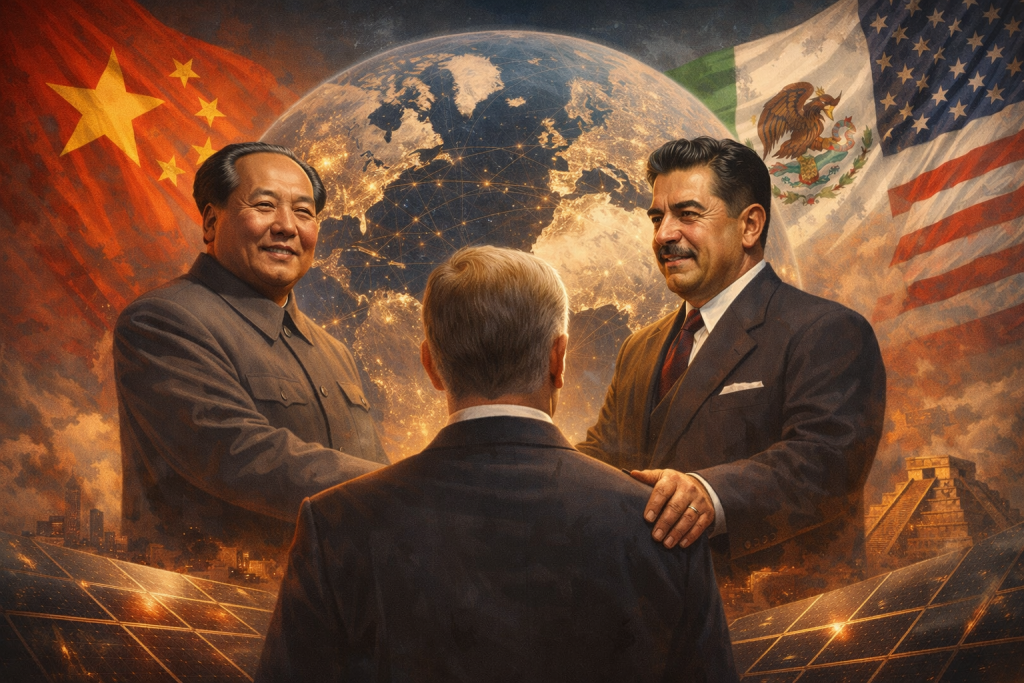
Mexico occupies a strategic yet delicate position between the world’s two largest powers.
- The United States remains Mexico’s primary trading partner
- China is both Mexico’s main industrial competitor—and a potential strategic partner
Mexico’s economic future will depend on its ability to:
- Diversify international economic relationships
- Strengthen energy sovereignty
- Integrate intelligently into reconfigured global value chains
Nearshoring has placed Mexico at the center of North American supply chain realignment—but geography alone is not enough.
Energy: The Decisive Factor of Economic Power
No global economic power exists without energy security and cost competitiveness.
China recognized this early:
- Massive investment in renewables
- Control of critical energy inputs
- Centralized energy planning
Mexico, by contrast:
- Possesses abundant natural resources
- Has a strategic geographic location
- Hosts a strong industrial base
Yet it faces structural challenges:
- Limited energy infrastructure
- Insufficient long-term investment
- Regulatory uncertainty
Without competitive energy, industrial growth stalls, foreign investment slows, and national development loses momentum.
Final Reflections: Strategy Over Passivity
The world is transitioning toward a multipolar order where absolute hegemony is fading. The ideological contrast between China and the United States is stark: financial dominance and protectionism versus state-led planning, technology, and long-term vision.
China and Mexico share more than is often acknowledged—ancient civilizations, strong cultural identity, social cohesion, and collective orientation. These intangible assets represent real political and economic capital.
Mexico must act with strategic clarity. Positioned between two global powers, it must rise to the challenge—particularly in energy, industrial development, and economic sovereignty.
The future is not predetermined. But one thing is clear: passivity is not an option.
LEASOL | Strategic Energy and Financial Advisory
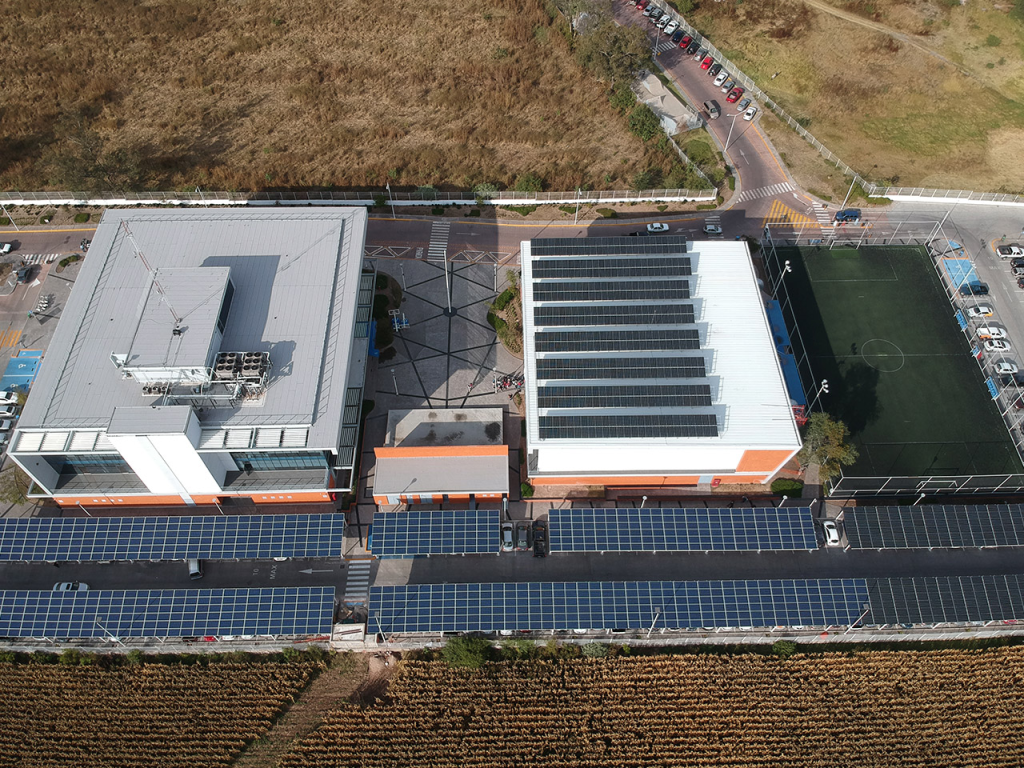
In this context of global economic and energy transformation, LEASOL stands as a Mexican company specializing in solar energy and strategic energy–financial advisory for businesses.
At LEASOL, we help organizations to:
- Structurally reduce energy costs
- Analyze return on investment (ROI) and financial viability
- Design long-term energy strategies
- Increase competitiveness in a demanding global environment
We believe that energy is the true axis of economic development, and that Mexico requires technical, financial, and strategic solutions to navigate the emerging global order.
📩 Contact: lrios@leasol.com.mx
LEASOL
Energy strategy for a multipolar world.